FeaturesGamesUse CasesPricingContact Us

Find the mole. blend in or get caught.

Everyone sees the same category and the same secret word. Everyone except the Mole, who only gets the category and has to bluff their way through it.

If you have played the one where somebody does not get the word, this is that, without anyone having to write on scraps of paper. It works around a table and it works on a video call.

3 to 20 players·Free for up to 10 players·In the room or over a call
Round 4

Category · Musical instruments

SAXOPHONE

Give a one-word clue. Say the word itself and you have given the game away.

One person in this room did not get a word

What actually happens

Your dinner table turns into a detective drama.

Eight friends around a table, phones face up. You deal a round. Seven of them see "Musical instruments" and the word "saxophone". One of them sees only the category. None of them know who got what.

You go round the table asking for one clue each, no saying the word. Someone says "jazz". Someone says "brass". The Mole, panicking but quick, says "smoky club". Everyone laughs. Suspicion moves. Someone says "that was too vague".

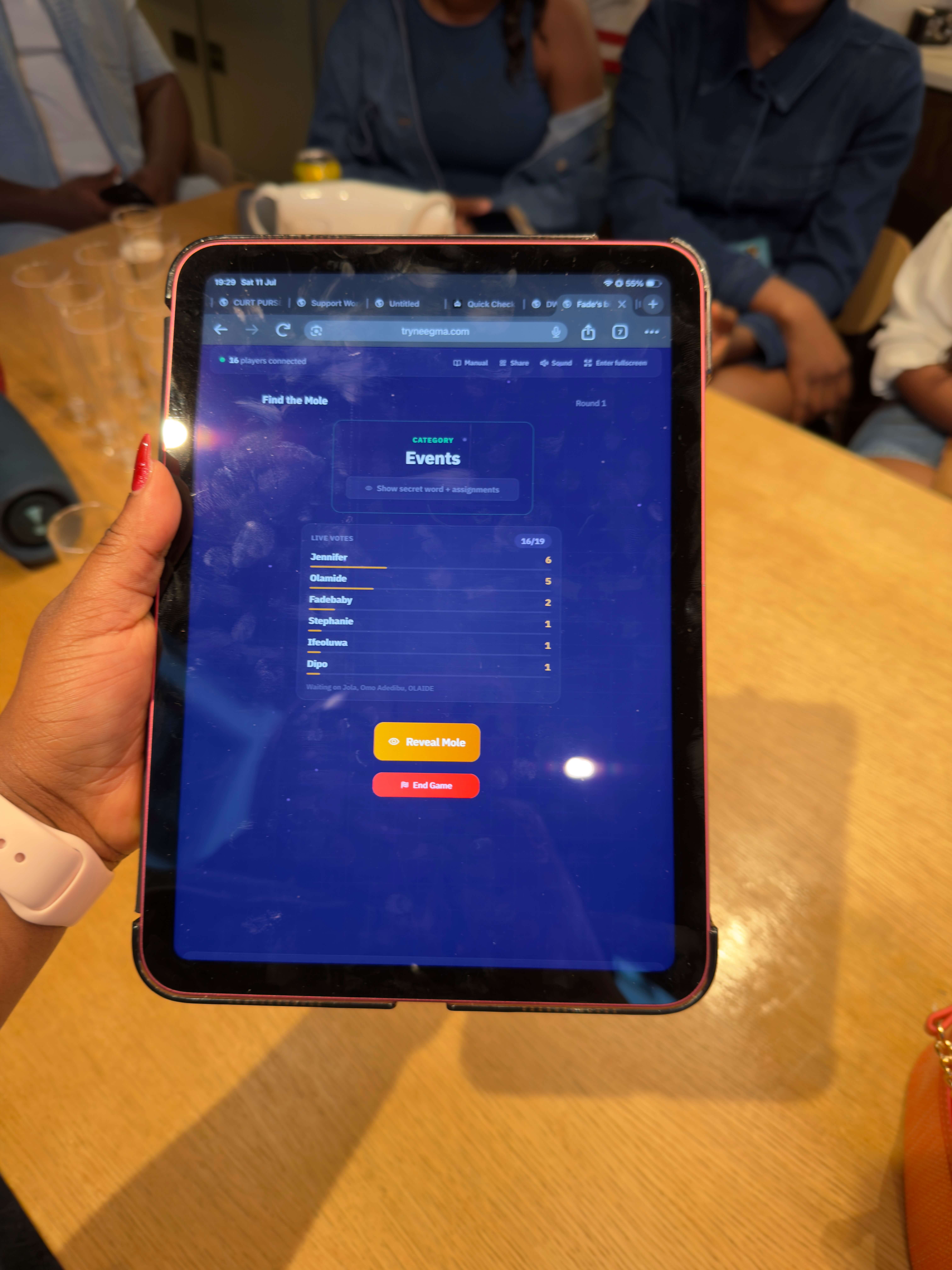
Then everyone votes from their phone and you watch the tally before you reveal anything. Catch the Mole and the voters bank points. Slip past the room and the Mole banks them instead. Next round, new word, new Mole, and now nobody trusts anybody.

The rules

How Find the mole actually plays.

How to play

  1. 1

    The host deals a category and secret word. Regular players see both; Moles see only the category.

  2. 2

    Each player gives a short spoken clue without saying the word. Discuss whose clue does not seem to fit.

  3. 3

    Vote for a suspect on your device. The host reveals the Moles, then deals a new round when the group is ready.

How to win

Correct votes earn 1,000 points if the Mole is caught, or 500 if they escape. Surviving Moles earn 1,000. The highest total across rounds wins.

What makes it work

  • Classic social deduction

    Blend in or get caught

  • Catch the Mole for full points, or bank half for spotting one the group lets slip

  • Words from the word library keep every round fresh

  • The Mole only sees the category, so they have to bluff a word they've never seen

  • The group vote always creates drama and accusations

  • 3 to 20 players, scaling from small groups to big parties

  • Moles are chosen each round, so anyone could be next

While you host

Choose the topic. Time the reveal.

You guide the conversation from the host screen, with a separate control for each step from dealing the word to showing the standings.

Leaderboard

After round 1

  • 1ADAda1st place1,000
  • 2BOBo2nd place500
  • 3CYCy3rd place0
Example running scores after a tied vote

Example final podium

Ada wins

Cy

1,000

2

Ada

2,000

1

Bo

500

3

Example totals after two rounds

Pick the next category.

Choose a category from the host's suggestions before each deal. Shuffle the suggestions for another selection; word difficulty and sensitivity follow your session settings.

Give the discussion its moment.

Use Start Voting when the room is ready. Watch the live tally, then confirm Reveal Mole after everyone has had their say.

Stay for another round.

After the reveal, show the running leaderboard. Next Round opens another category choice; Finish Game closes the game with the scores collected so far.

Make every clue count.

Around a table

Seat players where they can hear each clue and see one another, while keeping phones angled away from their neighbours.

On a video call

Share the host window and agree on a speaking order. Give each person space to finish their clue before anyone challenges it.

With remote guests

Repeat every clue into the room microphone and include remote players in the same speaking order as those at the table.

Use cases

Bring a little suspicion to your gathering.

Use a shared category to start a conversation, then let the vote give it a twist.

  • Team offsites

    The quiet clue changes the vote.

    Close a workshop with a few rounds and invite everyone to offer a clue before the debate starts. A hesitant answer can sound suspicious even when it is right. After the reveal, ask which clues changed minds and which assumptions led the group astray.

    Plan a team social
  • Dinner parties and birthdays

    Dessert comes with an accusation.

    Deal a food or music category between courses and let guests build their case from the clues. Friends who know each other well can still misread a bluff. Rotate who speaks first so the next Mole cannot always borrow ideas from the table.

    Explore party games
  • Meetups and conferences

    A first conversation, with suspects.

    Open a small networking group with one shared category instead of a round of job titles. Each person contributes a clue, then compares what they heard with the others. The reveal gives strangers a specific moment to discuss before they head into the main programme.

    Plan a conference icebreaker

Build a set around your subject, guests or occasion in the Playground.

Customise Find the mole

Player roles

The same category, different information.

Play individually, around a table or on a video call. Each player uses their own device for their card and vote, with roles assigned again each round.

Regular player

Prove you know the word.

Your card shows the category and secret word. Give a clue that fits, without making the answer obvious to someone who has not seen it.

Best for

careful clues and listening for inconsistencies.

Mole

Bluff from the category.

Your card tells you that you are a Mole and shows only the category. Use the conversation to give a plausible clue and avoid the vote.

Best for

improvising a convincing clue under suspicion.

Before you start

Find the mole questions

How many Moles are in each round?
There is one Mole with 3 to 8 players, two with 9 to 15, and three with 16 to 20. Roles are randomised each round, so someone can be a Mole more than once.
What happens if the vote is tied?
Nobody is caught. A Mole is caught only when they receive more votes than every other player. A surviving Mole earns 1,000 points; anyone who correctly voted for them still earns 500.
Is there a timer for giving clues?
No. The host sets the pace, invites clues and decides when to reveal the vote. You can keep rounds brief or allow more discussion before revealing.
Will the same word come up twice?
Within one game, Neegma chooses unused words from its library. Categories can come back with a different word; starting a new game begins a fresh selection.
How do players join?
Start a session and share its link or QR code. Players open it in their browser, enter a name and join you in the lobby. They don't need an account or an app. The joining guide covers team selection and what guests see next.
Can I use my own words?
Yes. Use Neegma's ready-made content or create a reusable set of words in the Playground. Type your own or import a spreadsheet, then shape the set around your subject, guests or occasion. You can edit and reuse your set whenever you host.
Can AI help me create a Find the mole set?
Yes. AI generation is available to every signed-in host, including the Free plan. Describe the topic and audience, review the preview, add the batch, then edit the questions before hosting. Each successful batch uses one credit. The AI guide explains credits and how to write a useful brief.
Can I include Find the mole in a ready-made event?
Yes. Browse free and paid session templates for prepared game lineups, or build your own template with Find the mole included. A template saves your game selection, order and available settings so you can run it again with another group. The template guide explains playlists and other session flows.
What can we play alongside Find the mole?
Neegma has 15 games in its library. Try Trivia for a quiz about your chosen topic, or browse all games to build a varied lineup. In a template session, the included games and session flow determine which game you can choose next.
Can we play in person, remotely or as a hybrid group?
Yes. Share the host screen on a TV, projector or video call, and have players join on their own devices. Neegma runs the game; your room or call carries the conversation. The screen-sharing guide covers the setup, and the large-event guide helps you plan for venue Wi-Fi and bigger audiences.
What happens if someone loses connection?
Return to the same browser tab on the same device and use Rejoin when it is offered. A new browser or device may be treated as a new player, and when someone can resume depends on the game. The reconnecting guide explains how to recover a place without resetting the whole group.
Can players share their results and keep their achievements?
Yes. After an online game finishes, players can use Share result to share or download their card. Save My Results emails the result and records an achievement, even before a player has an account. Signing up with the same email connects those saved results. Leave time to save before starting the next game.
How many people can play, and is it free?
The suggested group size is 3 to 20 players. The Free plan includes up to 10 players and 5 sessions a month, with no card required. For larger groups, compare a one-off Party Plan with a Pro subscription on pricing and choose the allowance that fits your event.

More about hosting? Visit the help center.

Deal the word. Find the bluff.

Bring at least three players and start your first round.